

Brand approval workflows: reducing revisions and preserving decisions
Review decisions and evidence before expression, and bind approval to a specific version and scope.

Key points
- Route review according to consequence and decision type.
- Make feedback identify the issue, evidence and acceptance condition.
- Verify approval, export and publication as separate events.
How can brand approval be both efficient and traceable?
Review the decision and its evidence before polishing expression. A proposal should identify purpose, audience, location, claim support, version and unresolved questions. Approval applies to the version and scope actually reviewed. Publication then needs a separate check against that decision. This avoids treating an approved label as permission for every subsequent change. The workflow below is an editorial operating recommendation. A record of approval does not prove the content is effective, safe or legally sufficient, and the article does not claim that a company has implemented a complete automated review system.
Scroll the diagram horizontally to read
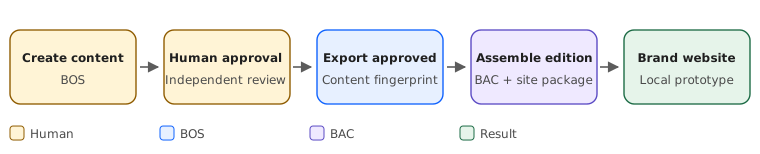
Repeated revisions often begin with the wrong review order
A team can spend hours adjusting a headline before discovering that the service promise is unsupported. “Make it feel more on-brand” also leaves the author guessing whether the issue concerns positioning, vocabulary or layout. Classify feedback as factual error, unmet need, standards failure, unresolved risk or expressive preference. The first categories need an identifiable basis, while a preference should be marked as mandatory or optional. Discuss questions that are ready for judgement. Return missing evidence to the person who can obtain it rather than repeatedly asking a group to vote on an unknown.
Step one: route review according to consequences
A routine change inside an approved template may use an owner check and sampling. A new promise, uncertain image rights or sensitive example needs the appropriate specialist and decision authority. GOV.UK's governance principles support timely decisions at the right level and clear authority boundaries.[S1] They do not prescribe a universal company approval ladder. Define triggers, required inputs, reviewer, deputy and pause conditions for each route. An urgent request can receive faster coordination, but urgency does not establish the truth of a claim or remove a necessary rights check.
Step two: prepare a decision package
Include purpose, audience, problem, channel, release conditions, proposal version and meaningful alternatives. Make a claim register for service statements, numbers, comparisons and image rights, with source, scope, unknowns and the responsible checker. Show the work in context, including mobile presentation and essential qualifications. Ask a concrete question such as whether to adopt wording that preserves an integration condition. General agreement cannot transform an unsupported company statement into a fact. An untested improvement figure is not acceptable merely because it appears in small print or because several people prefer it.
Step three: make comments actionable
A useful comment identifies location, problem, basis, consequence and an acceptance condition or suggestion. For example, a plan card omitting an integration charge may lead readers to misunderstand total cost; the correction should refer to the current offer conditions. When feedback conflicts, the driver frames the tradeoff for the right decision maker. Do not make the designer guess which stakeholder carries more authority. Track comments as resolved, not adopted with reasons, or pending confirmation. The number of messages is not evidence that the relevant questions were reviewed. Preserve significant unresolved issues rather than closing them for administrative convenience.
Step four: separate creation, approval and publication
The creator prepares material, reviewers check defined domains, the authorised person decides, and the publisher verifies the actual file and destination. Consequential claims need appropriate independent review. Where a small team lacks that capacity, record the limitation and narrow the promise instead of fabricating another reviewer. Atlassian's DACI distinguishes the person driving a decision from the person approving it.[S2] The publication check proposed here is an additional editorial application, not a claim that DACI supplies a complete release-control system. State which review covered facts, expression, rights or technical behaviour.
Step five: bind the decision to content and use
Record the question, approver, time, content version, source version, channel, conditions and open issues. A content fingerprint can help detect whether an exported item changed. It cannot establish factual accuracy or the validity of a person's authority. A later change to a claim, image, number or material limitation needs a fresh judgement about review, even if the filename remains unchanged. Conversely, an explicitly permitted format conversion may be checked under an existing rule. Keep a clear distinction between approved content, exported files and what was actually published.
Hypothetical scenario: an image changes after an article is approved
Imagine a technical article is approved, then receives a replacement diagram containing an external logo and information that has not been cleared for release. The text version may be unchanged, but rights and disclosure conditions have changed. The publisher pauses that image and obtains the required checks, or substitutes an appropriate public illustration. The final combination of text and image is checked again, with the published URL and version recorded. The scenario shows why approval of an article is not blanket permission for any accompanying visual. It does not establish a rights conclusion for any real image.
What should be checked and measured?
Sample cases with different consequences and trace proposal, feedback, approval and publication. Measures can include time after evidence becomes complete, cases reopened because assumptions were unclear, differences between approved and published material, and unresolved exceptions. Zero rejection may indicate weak review rather than good quality. Revision counts also need interpretation: changed scope, corrected facts and expressive refinements are different reasons for rework. Establish a baseline before setting improvement targets. A useful process makes important decisions reconstructable while allowing low-risk routine work to proceed within explicit boundaries.
Urgency, exceptions and automation
An exception needs scope, an expiry condition and any remedial work. It should not become a permanent bypass. AI can flag missing fields, apparent guideline differences or broken references, but authorised people remain responsible for commitments. Automated comparison can also miss an unchanged sentence whose underlying service conditions have expired. Connect review to source updates and withdrawal procedures rather than keeping only a green approval flag. A process designed for brand communication does not replace specialist legal, safety or regulatory review where those are required for the actual material and context.
A publisher can compare three columns: approved content, intended output and the live result. Check claims, images and essential qualifications, including readability after resizing. A production-file screenshot can miss stale assets, caching or broken links in the actual environment. This is release verification, not a reason to reopen every stylistic decision.
Frequently asked questions
Does resizing require approval again? A permitted conversion may use self-checking, but cropping that removes a qualification changes the content's effect. Can every expert veto? Define each expert's required conditions and escalation route instead of treating all advice as formal approval. Does every item need a meeting? No. Complete evidence and a clear decision can be handled asynchronously; conflict, material uncertainty or shared understanding may justify discussion. Keep the resulting decision tied to the actual version so that efficiency does not depend on forgetting what was approved.
Sources and evidence boundaries
- S1 · Governance principles for agile service delivery
Government Digital Service · Accessed 2026-10-22
Supports the cited principle; operational steps and illustrative scenarios are editorial recommendations rather than reported customer results.
- S2 · DACI Decision-Making Framework
Atlassian · Accessed 2026-10-22
Supports the cited principle; operational steps and illustrative scenarios are editorial recommendations rather than reported customer results.