Decision cards: people decide only what needs a person
When an AI hits a choice mid-work, written rules sort it three ways: handle it, put it on a decision card, or stop and wait for a person to act.

Key points
- When an AI hits a choice mid-work, written rules sort it three ways: handle it, put it on a decision card, or stop and wait for a person to act.
- A card holds at most seven numbered items, each with a recommendation and a note on reversibility; the person replies in one line, and anything unmentioned stays open.
- Every decision, including what the AI handled on its own, goes into an append-only ledger, so the reasons can be found later.
The marketing lead at a retail chain opens her messages one morning and finds more than twenty questions left overnight by an AI assistant. Which version of this image? Should the subject line include the campaign date? Is this paragraph too long? Should the list exclude people who bought last month? None of them is hard, but answering each one takes her whole morning.
Worse, only two or three of those twenty questions matter — like who to exclude from the list, because that touches real customers. Those few get buried among "which version looks better", and it is easy to reply "either is fine" without noticing.
The problem is not that the AI asks too much. It is that every question looks the same. We wanted a way for the AI to do what it can do on its own, hand what genuinely needs a person over in one clear place, and let the person answer in a single line. That is the decision card.
Every decision point goes one of three ways
When an AI reaches a point where it has to choose, it does not ask straight away. It first checks a written set of triage rules to see which path the choice belongs on.
- Handle it: things within the agreed scope that are easy to undo, like formatting or wording in an internal draft. The AI does it and lists it in one line of its report.
- Put it on a card: anything that changes scope or fields, cannot easily be undone, goes outside the company, may cost more than expected, or changes the rules themselves. The AI prepares options and a recommendation and waits.
- Needs the person: anything involving accounts, passwords or payment, which an AI never does on someone's behalf. The AI writes out the steps and stops.
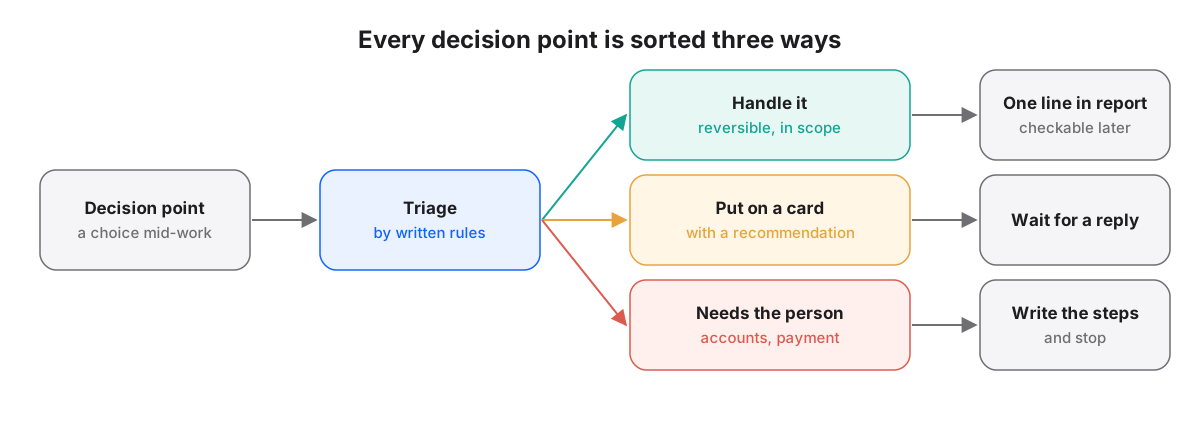
What matters is that the rules are written down. The AI does not have to guess whether it may do something, and people can open the rules at any time to see where the lines are and move them if they are wrong.
The rules also tell the AI which way to lean when it is unsure. If something could belong on two paths, it takes the more cautious one. Unsure whether it can handle something alone, it puts it on a card; unsure whether a person must act, it stops. One extra question costs far less than an irreversible mistake.
What a decision card holds
The things that truly need a person are collected into a decision card, with a few fixed requirements.
- No more than seven items. More than that means the AI has not handled what it could, or the card should be split.
- Each item is numbered and comes with the AI's recommendation and reasoning, so the person judges a proposal instead of starting from nothing.
- Each item says whether it is reversible. Reversible choices can safely follow the recommendation; irreversible ones deserve a second look.
- The card ends with a sample reply already filled in with the recommended options, ready to copy.
Back to the marketing lead. Now her morning starts with a single card of three items: exclude last month's buyers from the list (recommended yes, reversible); raise the campaign budget ten percent above the agreed cap (recommended hold, cost over plan); send the promotional email on Friday evening (recommended yes, external and irreversible once sent). The twenty smaller questions were handled under the rules and listed in the report.
The recommendation matters most. A question without one hands all the thinking back to the person; with one, the person only has to agree or disagree. We also ask for a one-line reason. If the AI cannot write one, the item usually is not ready for the card.
The reply is one line
The reply format is short: number, space, choice, with items separated by commas — "1 yes, 2 hold, 3 yes". To change something: "2 change: keep the budget at the agreed cap".
It looks like a convenience, but it does two more important things. It removes ambiguity: "sure, should all be fine" is hard to map to specific items, while "1 yes, 2 hold" cannot be misread. And the AI repeats the reply back before turning it into concrete tasks, so a typo gets caught before anything happens.
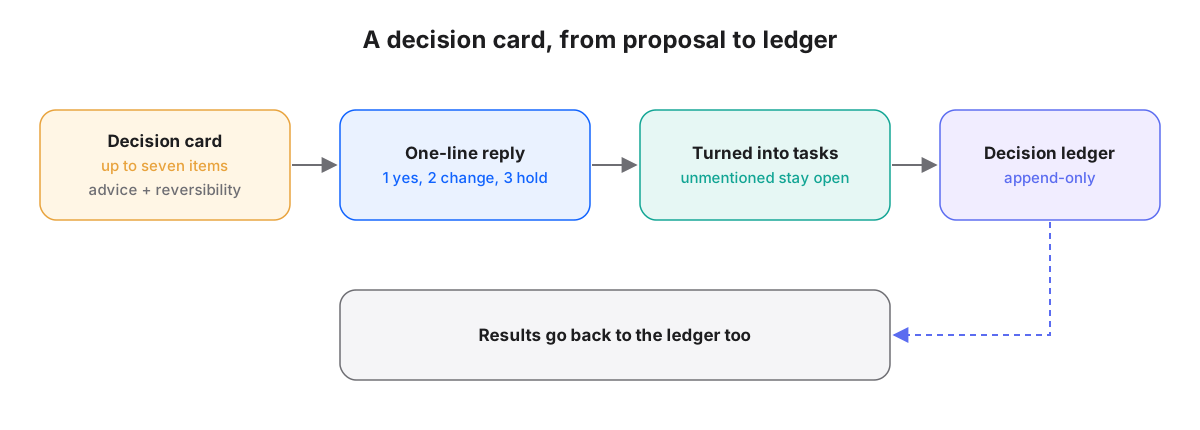
We also keep the reply from turning into a conversation. If the person has a question about an item, they reply "2 change: explain why the budget goes over first". The AI adds the explanation and brings the item back on the next card, rather than starting a long back-and-forth. Each card has a clear start and end, and each one maps to entries in the ledger.
Two paths: routine and urgent
Most decisions can wait. They accumulate and are gathered into a card at a set time, instead of interrupting someone every time a question appears.
Only a few kinds of things are urgent, and they are listed in advance — an external write that failed or whose result is unknown, a key delivery date close at hand with the work stuck, a suspected credential leak. Only those trigger an immediate notice, and there is a daily cap on alerts; anything beyond it is merged into one message. When a notice arrives, people know it really needs them now.
Everything goes into the ledger
Each decision is written to an append-only ledger: date, item, options, the AI's recommendation, the person's reply, and what happened afterwards. Things the AI handled on its own are recorded too, marked as handled under the rules.
The ledger earns its keep months later. When someone asks why last month's buyers were excluded, the answer is a line in the ledger, not someone's memory. And if a type of question always gets "yes", the person can say "don't ask about this kind again", and the AI adds it to the triage rules. Bit by bit, the rules come to reflect how the team actually decides.
A good decision card lets people spend their time on the choices only people can make.
In short
- Written rules sort each decision point into handle it, put it on a card, or wait for the person.
- A card holds up to seven items, each with a recommendation, reasoning and reversibility, plus a ready-to-copy reply.
- People reply in one line; skipped items stay open, and silence never counts as approval.
- Every decision goes into an append-only ledger, and repeated judgments can become new rules.