Measuring brand visibility in AI search
Customers ask AI now; what matters is whether you are mentioned, and how.

Key points
- AI answers are assembled from sources; consistent, verifiable brand facts are more likely to be cited correctly.
- Ask a fixed set of questions on a schedule, record sources and claims, compare with approved facts, fix the sources, and re-check.
- Repeated patterns become candidates and turn into rules only after a person confirms; brand facts are confirmed and locked once, then cited everywhere.
Not long ago, someone looking for a shop or comparing two products would open a search engine and scan the first few links. More and more people now simply ask an AI: "Which restaurant nearby is good for bringing older relatives?" "What is the difference between these two brands?" What comes back is not ten links but a single, tidy answer.
That raises a new question: does your brand appear in that answer? And if it does, how is it described? Are the opening hours right, is the service area correct, has someone else's strength been attributed to you? This post explains how we turn that question into work that can be measured, fixed and tracked over time.
How AI answers are put together
An answer engine does not "know" your brand. When asked, it selects, compares and summarises from the sources it can find, then writes a fluent paragraph. Those sources might be the brand's website, third-party reviews, news coverage, business directories, or an old profile nobody has updated in years.
The consequence is simple: the more consistent the sources, the steadier the answer. When sources contradict each other, the model has to guess, or leaves the point out. If the website says closed on Mondays, a directory says Tuesdays and a review says open every day, which one makes it into the answer is close to luck.
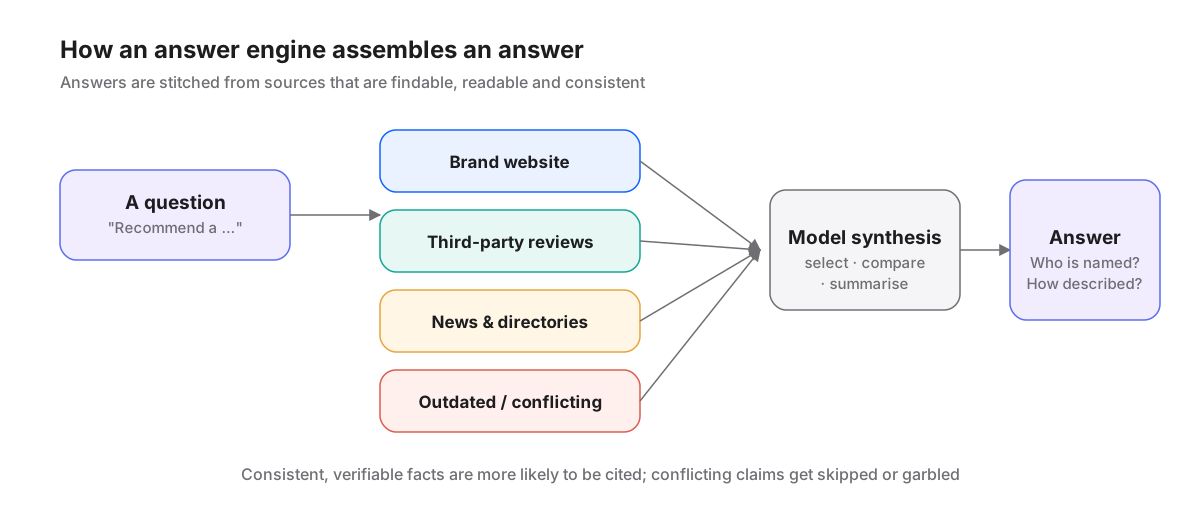
So when we talk about visibility in AI search (sometimes called AIEO), the goal is not to make the AI "like" you. It is to make the facts about you clear, consistent and well supported wherever they appear.
Why consistent, verifiable facts matter most
Imagine asking a friend to recommend a shop. If they have heard three different stories, they will probably stay vague, or repeat whichever one stuck. Answer engines behave in a similar way: they lean towards claims that are corroborated in several places and are more cautious with isolated or conflicting ones.
The first step, then, is not to write more content. It is to answer a plain question: which facts about this brand are true? How the name is written, what services it offers, which areas it serves, opening hours, contact details, and how it genuinely differs from similar brands.
That list also becomes the answer key for every later check. Without it we cannot tell whether an AI answer is right or wrong; we can only go on impressions.
A repeatable diagnosis loop
With an answer key in place, we can start measuring. The loop we use is simple, but it asks for discipline:
- Ask: prepare a fixed set of questions covering situations customers really ask about, such as recommendations, comparisons, prices and locations. Ask the same questions every round so that change is visible.
- Record: note which sources appear in each answer and what is said about the brand, claim by claim, rather than only whether the brand was mentioned.
- Compare: check each recorded claim against the approved facts and mark it correct, wrong, outdated or missing.
- Fix sources: errors usually trace back to a source. We correct that source, or add clear, checkable official information, rather than trying to "fix the answer".
- Re-check: ask the same questions again on schedule and see whether the fixes have come through.
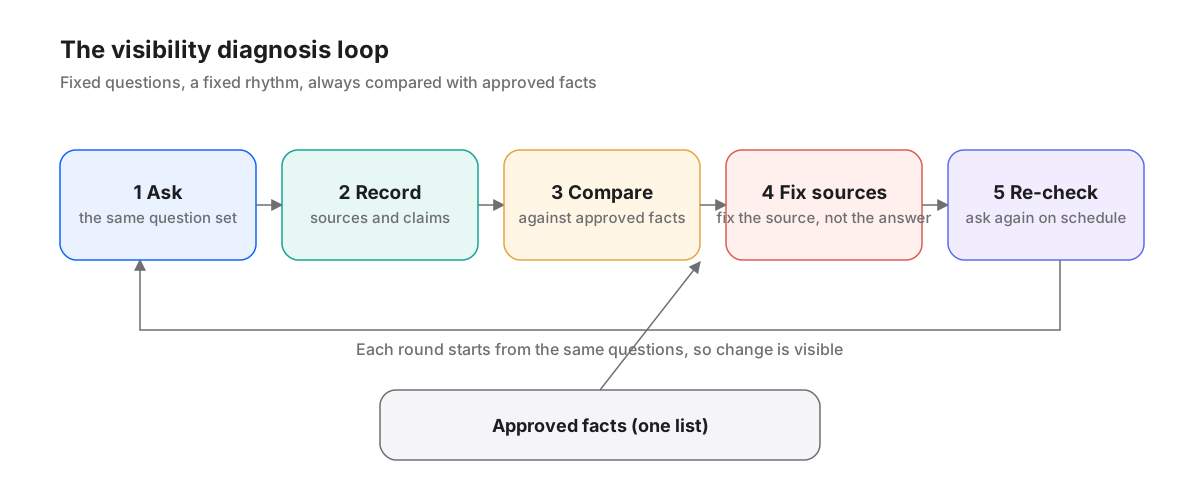
The loop deliberately ignores day-to-day swings. AI answers naturally vary with wording, timing and model versions, so a single result means little. Fixed questions and a fixed rhythm are what separate noise from real change.
Turning experience into rules, with a person in charge
After a few rounds, patterns start to repeat. A certain kind of question keeps citing the same outdated directory; comparison questions keep leaving out a particular service. These observations are valuable, but we do not let them become rules automatically.
Instead, a pattern seen three times becomes a candidate rule, and a candidate only takes effect once a person has reviewed and confirmed it. That person can accept it, edit it or send it back; rejected candidates simply go back to being observed.
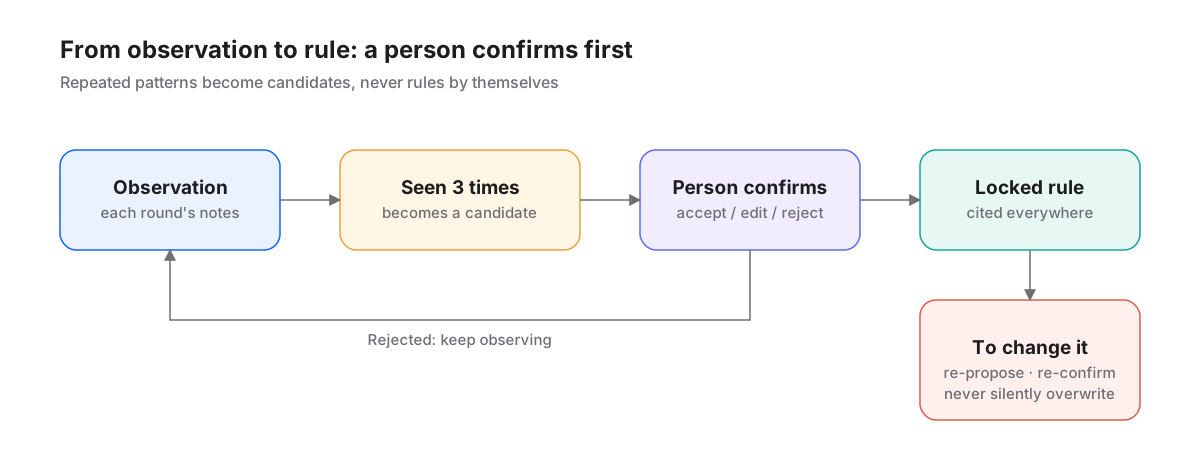
Repetition tells you something is worth noticing. Confirmation tells you it is safe to act on.
There are two reasons for this. First, when AI helps organise the data, it can mistake coincidence for a pattern, and human judgement catches that. Second, once a rule is confirmed it is locked and cited just like a brand fact. Changing it means proposing and confirming again, not letting a newer result quietly overwrite it.
What we actually measure
"Was the brand mentioned?" is only the starting point. Being mentioned ten times is not good news if half of those mentions get the opening hours wrong. So each round we look at several things together:
- Mentions: in how many answers to the question set the brand appears, and in which situations it is absent.
- Accuracy: when it is mentioned, how many claims match the approved facts and how many are wrong or out of date.
- Sources: which sources the answers cite or rely on, and how many of them the brand can maintain itself.
- Conflicts: how many versions of the same fact appear across sources. This is usually where to look next.
None of these numbers is a goal in itself. They decide what to fix first. If errors cluster around one directory, start there. If the brand keeps missing from comparison questions, its official information may never clearly say how it differs.
You do not need many questions to begin. A dozen or so that reflect real customer situations, plus a confirmed list of facts, is enough to run a first round and see the most obvious gaps. Add questions gradually based on what you find, rather than designing a huge list up front that nobody maintains.
In short
AI search does not change whether you need to be seen; it changes how you are described. Visibility work therefore returns to the basics: get the facts right, keep them consistent, and make sure each one is well supported wherever it appears.
- Answers are built from sources, so tidy the sources rather than chase single results.
- Confirm and lock brand facts once, then cite the same list everywhere.
- Diagnose with fixed questions on a fixed rhythm, fix the source, then re-check.
- Treat repeated patterns as candidates; a person confirms before they become rules.