Why facts need versions
Company facts change; versions show who cited which one.

Key points
- Company facts are confirmed and locked as versions, and projects cite them by number. A change means a new version, so old citations are never quietly rewritten.
- Facts have one single home. Working areas are free for drafting, but there is only one reviewed path into the home.
- IDs come from one registry with old names kept as aliases, the event log is only ever added to, and a checkmark needs evidence, not an AI saying "done".
A retail chain's return window used to be seven days. One day the company decides to extend it to fourteen. The website is updated, but the customer service reply templates still say seven, so does the promotional email, and the AI assistant answering customers is quoting a slide deck from three months ago. Customers get three different answers, and the service team spends an afternoon apologising.
Nobody was lazy. Facts change: prices are adjusted, specifications are revised, contacts move on. The real problem is that when a fact changes, we don't know who is still citing the old version.
As more work goes to AI, the problem grows. AI reads fast and writes fast, and it can copy an outdated number into ten documents in seconds. So we decided company facts should have versions, just like code.
Confirm and lock before citing
Before a project can cite a fact, the fact passes through three states:
- Draft: still under discussion. Anyone can suggest changes, but it can't be formally cited.
- Confirmed: a named owner has reviewed it and agrees it is what the company currently says.
- Locked: the content is frozen and given a version number. From that moment on, it doesn't change.
What if the fact changes after it is locked? We don't edit the old one. We issue a new version. Seven-day returns is version one; fourteen days is version two. Both exist side by side, each one clear.
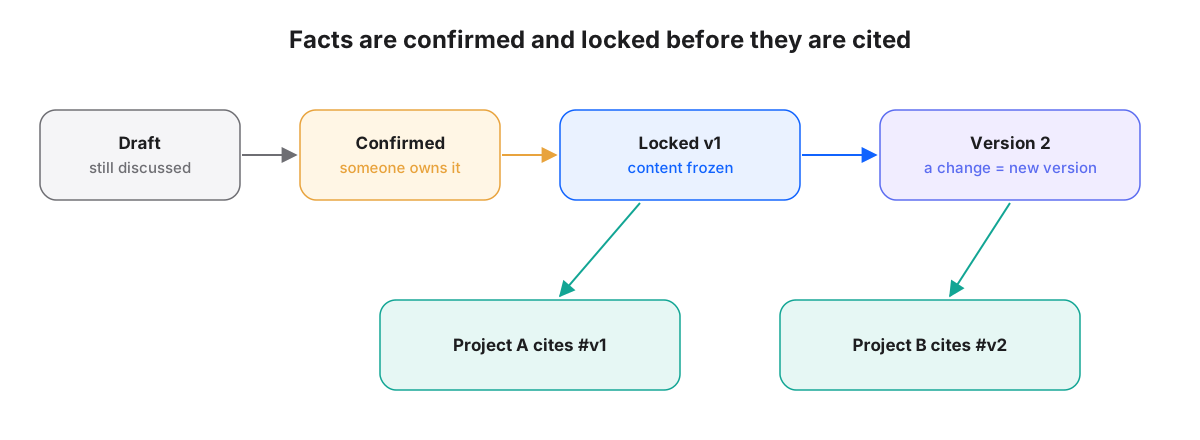
When a project cites a fact, it cites a number plus a version instead of copying the text. So when version two appears, we only have to ask one question: "Who is still citing version one?" The answer is a list, not a guessing game.
One home, many working areas
Facts need a home, and only one. If the same price list lives in three folders, sooner or later two of them will disagree, and nobody will be able to say which one counts.
We also know that work needs room. A marketing project wants to try several phrasings; an AI needs to draft before it revises. So we keep two things apart:
- The single home holds confirmed company facts, exactly one copy, and everyone reads from it.
- Working areas: every project and every AI can have its own working area to draft and revise freely without affecting anyone else.
A single write path connects the two. For anything in a working area to become a company fact, it must be reviewed before it is written into the home. There are no shortcuts, and no "I'll put it in now and get it reviewed later."
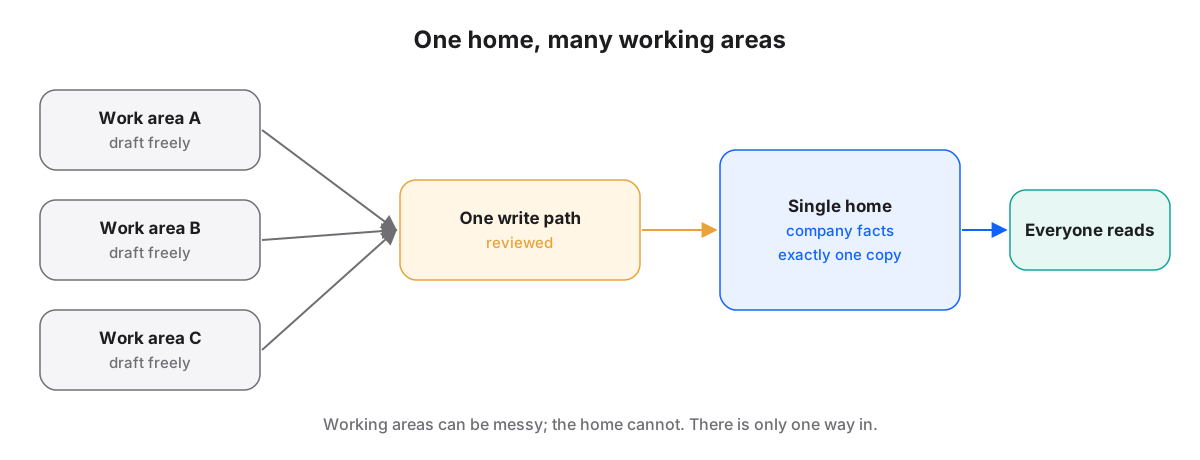
Working areas can be messy; the home cannot.
This matters especially when several AIs work at once. Different AI tools can work in parallel in their own areas without overwriting each other, while writes that affect the whole company go through one path, one at a time: queued, reviewed, then written into the home.
Every ID comes from one registry
A version can only be cited if its number is reliable. If two people each gave a different fact the same number on the same day, every citation would get tangled.
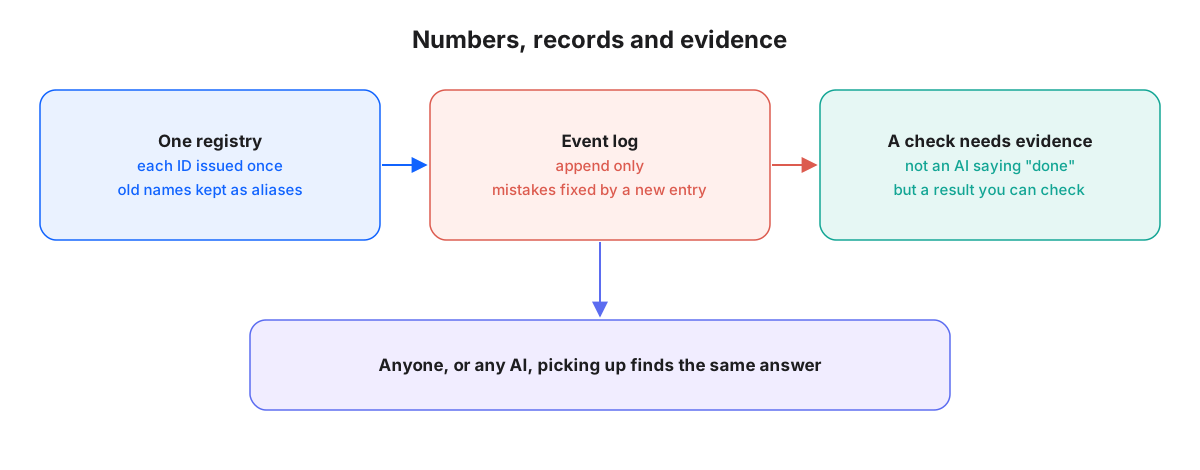
So every ID is issued by a single registry. Anyone who needs a new number gets it there, and the number is guaranteed to be unused.
Another common case is renaming. A document called "Return rules" is later renamed "After-sales policy". If the old name simply disappears, every person and AI looking for it by that name comes up empty. So we keep the old name as an alias: the new name finds it, the old name finds it too, and both point to the same thing.
The event log is never edited
Every confirmation, lock, new version and rename leaves an entry in the event log. The log has one strict rule: entries can only be added. Nothing already in it can be edited or deleted.
What if something was recorded wrongly? You add a correction that explains what the earlier entry got wrong and what is right. That looks like more work than simply editing, but it makes the log a history you can trust. Anyone looking back can see how things got to where they are today, mistakes included.
A checkmark needs evidence
The last principle is the simplest and the easiest to forget: a task can only be marked done if evidence comes with it.
AI is very good at saying "done." It may really have finished, or it may only think it has. For us, an AI saying it's done is not evidence. Evidence is something another person can check: a published page, a record you can look up, a check that passed.
- A checkmark without evidence is treated as not done.
- Evidence must be understandable and checkable by someone other than the author.
- In a spot check, you look at the evidence itself, not the tick in the report.
This rule ties versions, IDs and records into one complete chain. When a new colleague or a different AI tool picks up the work, it doesn't need to rely on anyone's memory. It follows the chain and finds the same answer.
A worked example
Back to the return window. Once the company decides on fourteen days, the owner drafts the new wording in a working area and submits it for review. Once approved, the home gains version two of "return window", and the event log gains an entry: when, who confirmed it, and which version it replaces.
The system then lists every place still citing version one: the service reply templates, the promotional email template, the AI assistant's reference material. Each becomes a to-do item, and it can only be ticked once evidence is attached, such as a link to the updated template. Old emails don't need changing, because they clearly show they cited version one at the time.
Three months later, if a customer turns up with an old email, the service team doesn't have to guess. They look up the version that email cited and can explain the rule then and how it differs now. Facts change, but every change is visible and traceable.
In short
- Facts are confirmed and locked as versions, and projects cite them by number and version. A change means a new version.
- There is one home. Working areas are free for drafting, and there is only one reviewed path in.
- IDs come from a single registry, old names stay as aliases, and the event log is only ever added to.
- A checkmark needs evidence someone else can check. An AI saying "done" doesn't count.