

Brand operating system (BOS): turning strategy into daily work
Connect brand decisions, approved content, handoffs and feedback into everyday work.

Key points
- Start with decision rights before selecting software.
- Separate approved brand content from website assembly and publication.
- Test real revision and withdrawal tasks rather than counting documents.
What is a brand operating system?
A brand operating system, or BOS, is a practical way to make brand strategy influence everyday decisions. It connects positioning, promises, evidence, content versions, responsibilities and feedback. It can begin with documents and a shared register rather than a new software purchase. Ask a concrete question: when someone prepares a proposal or changes a website statement, can they find the valid wording, identify who approved it and explain why it is appropriate? BOS is used here as a method and system boundary, not a universal certification or a claim that every feature is commercially available at AiTOM. IBM’s official design-language site provides an observable example of connecting principles, resources and implementation guidance.[S1]
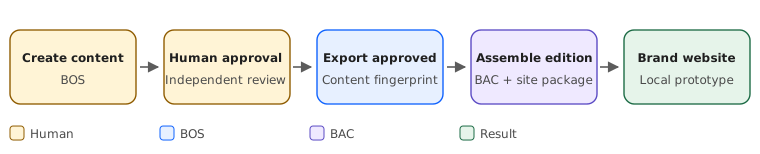
Scroll the diagram horizontally to read
Why do teams drift even when guidelines exist?
The usual failure is a broken chain of work. A guide says the brand should be trustworthy, but sales cannot locate evidence for a claim. Marketing renames a service while support continues using an older description. A design is approved but a different website version is released. Teams improvise because the guide describes style without explaining where facts come from or how changes travel. Trace one actual request through intake, evidence gathering, drafting, review, publication and feedback. Record the files and handoffs at each step. Do not assume that AI or moving everything into another platform will resolve ownership or version conflicts.
What information and responsibilities come first?
Build a minimum brand decision register with these fields: topic, valid wording, supporting evidence, intended audience, limits of use, content owner, approver, version, effective date and review trigger. The company supplies names and dates; software should not invent them. Unsupported claims remain candidates. Retired statements remain available for traceability but are kept out of the current-use collection. Distinguish the requester, fact provider, writer, approver and publisher. One person can hold several roles in a small team, provided each action is attributable. The public Service Standard supports multidisciplinary operation, explicit success measures and iteration. Applying those principles to a brand register, and choosing these particular fields, is an editorial recommendation.[S2]
How should a revision move through the system?
Consider a request to add a capability to a service description. The requester supplies the customer question and intended placement. The fact provider identifies what currently works, what remains incomplete and which evidence may be public. The editor submits a change comparison rather than only a polished final sentence. The reviewer checks whether the promise exceeds deliverable scope. Approval creates a valid content version. The publisher assembles the page from that version and records its URL, content version and release result. A rejection also needs a destination: retain why a phrase such as full automation was rejected, replace it with the supported steps, or withhold it. The next editor should not have to rediscover the same boundary.
How should BOS, content assets and publishing be separated?
Separate four responsibilities. BOS supports the creation and human approval of brand content. The content-asset layer preserves approved versions and usage limits. A website foundation reads a specified version and assembles the interface. Publication delivers that artifact to an environment and retains a receipt. This allows content accuracy and deployment success to be checked independently. A website maintainer fixing layout should not accidentally promote an unapproved brand candidate into the company description. If a brand asset center, or BAC, is involved, specify whether it retrieves approved content and supports assembly or has separate editing responsibilities. These are recommended boundaries, not claims about any product’s implemented permissions, security or integration maturity.
Illustrative scenario: three teams sharing one promise
Imagine a consulting company with sales, content and delivery teams sharing a service promise about knowledge retrieval. Delivery supplies a demonstrable workflow and its limitations. Content describes organizing sources, preserving versions and assisting retrieval. Sales uses the same approved version in a proposal. Without measured results, none of the teams claims a percentage of time saved or presents a test screen as a customer outcome. Pilot the process with two proposals and one website page. Ask a colleague unfamiliar with the original material to find evidence, revise wording, request approval and withdraw an obsolete version. Record every point where they cannot find information or confuse a candidate with approved content. The quantities are adjustable pilot scope, not performance targets.
Which measures show that the system works?
Measure work rather than document volume: time to find a valid version, correct-reference rate in sampled outputs, reasons for rejection, waiting time between approval and publication, and continued use of withdrawn content. Define the clock and denominator first. Correct-reference rate could mean sampled outputs citing the valid version divided by all sampled outputs. Attendance at a training session is not adoption. Establish a baseline before setting a target. Test an ordinary revision, a rejected claim, an urgent correction and an absent approver. Every case should expose the reasoning and resulting usable version. Improvement in these operational measures is useful evidence about this workflow; it does not independently establish higher brand equity, pricing power or revenue.
Which approaches undermine a BOS?
A BOS fails when it becomes a large file repository without a recognizable current version, routes every minor correction through one overloaded executive, governs visuals while ignoring delivery promises, or lets AI assemble new company facts from old material. Use risk-based review: layout fixes, reuse of approved language, new factual claims and consequential promises need different checks. If the company has not clarified positioning or established a stable offer, use a small decision register to track hypotheses and learning. Do not portray exploration as a mature operating standard. Software selection follows responsibility and tasks. Claims of automatic synchronization, zero errors or universal adoption require implementation evidence and should never be inferred from a diagram.
Frequently asked questions: team size, AI and starting order
Does a very small team need this? If colleagues repeatedly lose the current version, debate the same promise or cannot trace a claim, they need a minimum workflow, not necessarily another department. Make one frequent task work before expanding. Can AI approve brand copy? It can compare versions, flag unsupported sentences and draft candidates, but a person remains responsible for factual promises and publication. Passing an automated check proves only that the configured checks passed. What should the first week produce? One usable service description with evidence, responsibilities, a completed revision record and a withdrawal exercise. If another colleague can repeat the task, there is an inspectable foundation for deciding what to systematize next.
Sources and evidence boundaries
- S1 · IBM Design Language
IBM · Accessed 2026-10-22
Supports the cited principle; operational steps and illustrative scenarios are editorial recommendations rather than reported customer results.
- S2 · Service Standard
UK Government Digital Service · Accessed 2026-10-22
Supports the cited principle; operational steps and illustrative scenarios are editorial recommendations rather than reported customer results.