

AiTOM
The foundation under every product
Governance, knowledge, agents and interface: four layers that keep AI work traceable and in human hands.
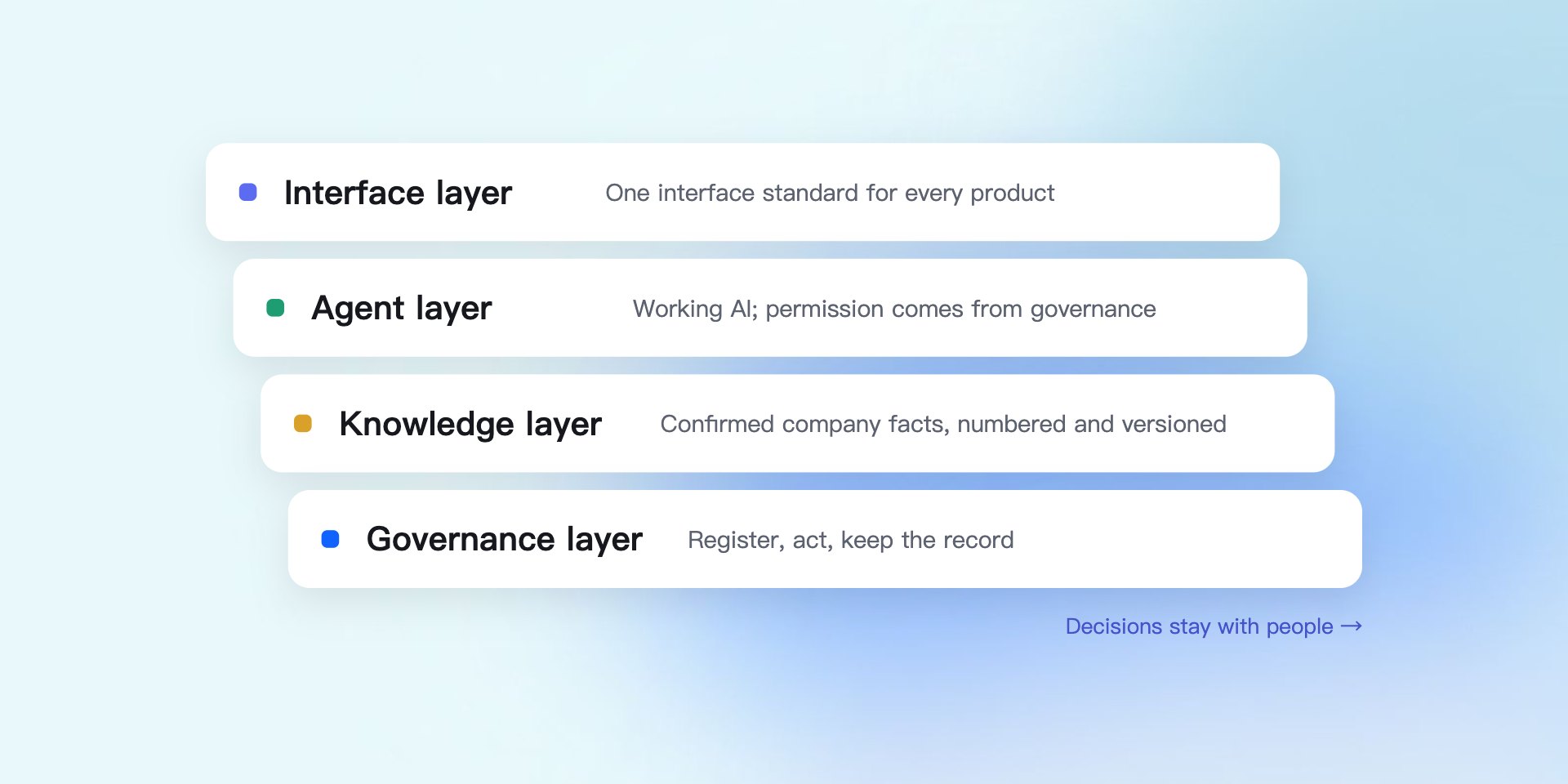
Four layers
Core principles
Files are the source of truth
Chat is not the record; work lands as readable, versioned files.
Never overwrite
Read before writing; merge or pause when someone else changed it.
Anyone can pick it up
Work trees, hand-off cards and snapshots let anyone, or any AI, continue.
People decide
AI drafts and reminds; accountable decisions stay with people.
Tech notes
 Enterprise AI readiness: assessing data, processes, people and governanceAI transformation · Oct 22, 2026
- AI opportunity discovery: identifying worthwhile business use casesAI transformation · Oct 22, 2026
- AI project prioritization: comparing value, cost and riskAI transformation · Oct 22, 2026
- Enterprise AI roadmap: from pilots to cross-functional adoptionAI transformation · Oct 22, 2026
- AI proof of value (PoV): deciding whether a pilot should scaleAI transformation · Oct 22, 2026
- Workflow diagnosis: finding rework, delays and handoff gapsAI transformation · Oct 22, 2026
- Human–AI collaboration: allocating tasks, decisions and responsibilityAI transformation · Oct 22, 2026
- Enterprise AI operating model: coordinating platforms, teams and business unitsAI transformation · Oct 22, 2026
- End-to-end process redesign: improving the whole workflow with AIAI transformation · Oct 22, 2026
- Enterprise knowledge management (KM): knowledge people and AI can useAI transformation · Oct 22, 2026
- Enterprise RAG and trusted retrieval: sources, permissions and answer qualityAI transformation · Oct 22, 2026
- AI workflows and agents: tools, state and human approvalAI transformation · Oct 22, 2026
- Enterprise AI model and platform strategy: capability, cost and data governanceAI transformation · Oct 22, 2026
- Responsible AI governance and access management: principles in practiceAI transformation · Oct 22, 2026
- AI system evaluation: assessing quality with test sets and evidenceAI transformation · Oct 22, 2026
- AI skills and adoption: from tool use to team-wide practiceAI transformation · Oct 22, 2026
- AI value realization: tracking outcomes and improving over timeAI transformation · Oct 22, 2026
 Measuring brand visibility in AI searchAI search · Oct 11, 2026
 How the interface standard controls colour and accessibilityInterface · Oct 11, 2026
 Six planes: how an AI company's infrastructure is layeredArchitecture · Oct 11, 2026
 One registry, one gateway: plugging every piece into the governance baseGovernance · Oct 11, 2026
- An agent charter where every rule grows from a real scenarioGovernance · Oct 11, 2026
- Why AI cannot grant itself permissionGovernance · Oct 10, 2026
- How the interface system assembles every page from modulesInterface · Oct 10, 2026
- How several AIs share one workspaceCollaboration · Oct 10, 2026
 Why facts need versionsKnowledge · Oct 10, 2026
- A brand knowledge base AI can search and citeKnowledge · Oct 9, 2026
 Cold start and recovery: bringing a new machine back to workPlatform · Oct 8, 2026
- Design tokens and component versions: interfaces you can rebuildInterface · Oct 8, 2026
 Goal chains: tracing every task back to strategyStrategy · Oct 7, 2026
- Platform updates: small changes flow, big ones wait for peoplePlatform · Oct 7, 2026
- How tags become a database and a knowledge graphKnowledge · Oct 6, 2026
- The AI learning loop: a three-time threshold and human sign-offKnowledge · Oct 6, 2026
- Hundreds of agents at once: waves, sampling and intakeCollaboration · Oct 5, 2026
- Data levels: what can be handed to AIKnowledge · Oct 5, 2026
- External actions: no duplicates, reconcile firstGovernance · Oct 4, 2026
- AI handoffs without amnesia: continue from files, not chatCollaboration · Oct 4, 2026
- Append-only event logs: never edit, always correctGovernance · Oct 3, 2026
- Decision cards: people decide only what needs a personGovernance · Oct 2, 2026
- Work trees: making every project easy to pick upCollaboration · Oct 1, 2026
Talk tech with us
Start from your question.