A brand knowledge base AI can search and cite
Brand facts enter a quarantine first, pass checks, and are approved by a person in batches before becoming versioned, traceable Authority. AI can't write there directly.

Key points
- Brand facts enter a quarantine first, pass checks, and are approved by a person in batches before becoming versioned, traceable the fact store. AI can't write there directly.
- AI reads facts through a read-only query layer, and every result comes back with its source and version, so every answer can be checked.
- When there's no approved fact, the answer says so and marks the gap as pending, instead of filling it with something that sounds plausible.
Ask an AI assistant to write a brand introduction and you'll usually get smooth, polished, professional-sounding text. The trouble is telling which sentences have a basis and which are just what brand introductions usually say. Founding year, scope of services, primary colour, tagline: if even one is made up, the whole paragraph can't go out.
That isn't the AI being dishonest. It just has nowhere to look. When brand knowledge is scattered across slide decks, chat logs and someone's memory, all an AI can do is guess. This article explains how we give brand knowledge a home that AI can search and cite.
Facts need a single home
The first step is deciding where brand facts live. Our answer is a separate authoritative fact store, and official brand facts exist only there. How the name is written, which terms to use, what the core claims are, which phrases are off limits: each is a record in that store.
"Single" matters. If one fact has a version in three documents, one of them will go stale sooner or later, however well-meant. So anywhere else that needs the fact references it instead of copying it. A project document says "see this fact", rather than pasting the content again.
The the fact store store is version-controlled, and only designated people can approve a change. Every edit records who, when and why, and old versions are kept. That lets us answer a very practical question: which version of the facts did last month's proposal use?
It's also worth being clear about what counts as a fact. A sentence can become a fact if it answers three questions: what it says, where it came from, and who agreed it could be said. A feeling like "our brand is warm" belongs in voice guidance, not in a citable fact. The official spelling of a name, or the formal name of a service, is what AI needs most and gets wrong most easily.
Separating facts from opinion has another benefit. AI can be free with tone when writing, but for hard information such as names, numbers and claims it has to check the store. Writing vividly and writing correctly stop pulling against each other.
How new claims get in: quarantine, checks, human approval
Facts don't appear from nowhere. They come from documents, interviews, websites and meetings, and those sources vary in quality and often contradict each other. If everything went straight into the fact store, it would soon stop being authoritative.
So new claims always enter a quarantine first. Think of it as an inbox: things have arrived, but they aren't official. Then comes a round of mechanical checks: is the format complete, does it duplicate an existing fact, does it conflict with one? After that, a sample review, and finally human approval.
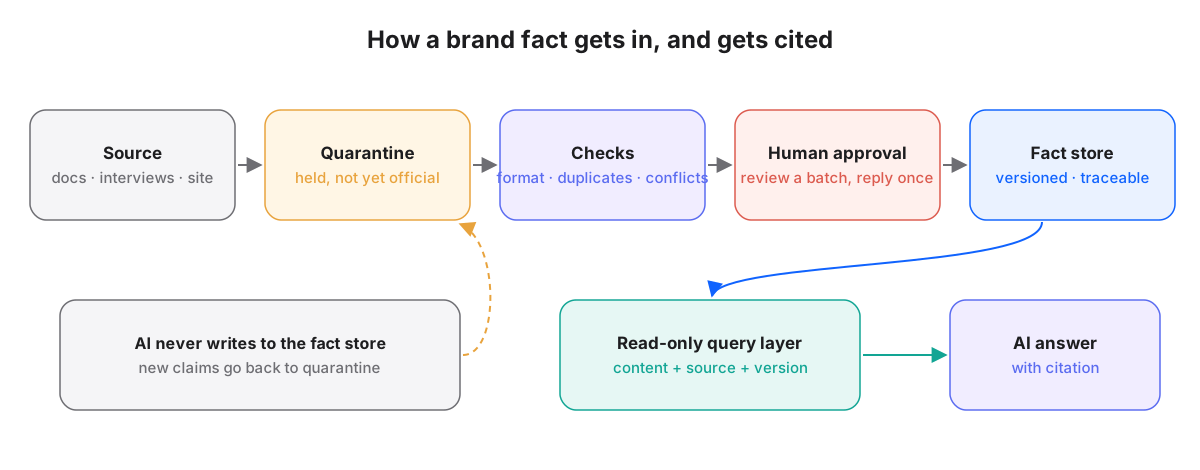
We deliberately designed approval as "review a batch, reply once". Not a meeting per fact, but a list of candidates, each with its source and check results, and a person replies item by item: yes, change, or not yet. Human judgement stays in the loop without approval becoming a bottleneck that never clears.
How AI reads: a read-only layer that returns sources
With the store in place, the next question is how AI uses it. We don't let each project copy the facts over. Instead there's a read-only query layer, and everyone checking status and every AI looking something up goes through that one entrance.
Read-only means exactly that: you can read through it, not change anything. Any write has to go back through quarantine. That makes it safe to open the layer to many AI assistants at once, without worrying that someone breaks something while looking things up.
The format of what comes back matters even more. Each result includes not only the content but also its source and version: which fact it is and which approved version it came from. The AI can then say clearly in its answer which fact it relied on.
A single entrance brings an underrated benefit: different AI tools get the same answer. One assistant drafts a proposal today, another edits website copy tomorrow, and both find the same fact at the same version. Brand consistency no longer depends on which tool happened to read which document, only on everyone reading from the same place.
An answer you can check
So a good answer isn't just a sentence. It has four parts.
- Claim: the sentence in the answer, such as "the brand's primary colour is deep-sea blue".
- Source: which fact the sentence is based on.
- Version: which approved version of that fact.
- Status: approved, pending, or no record.
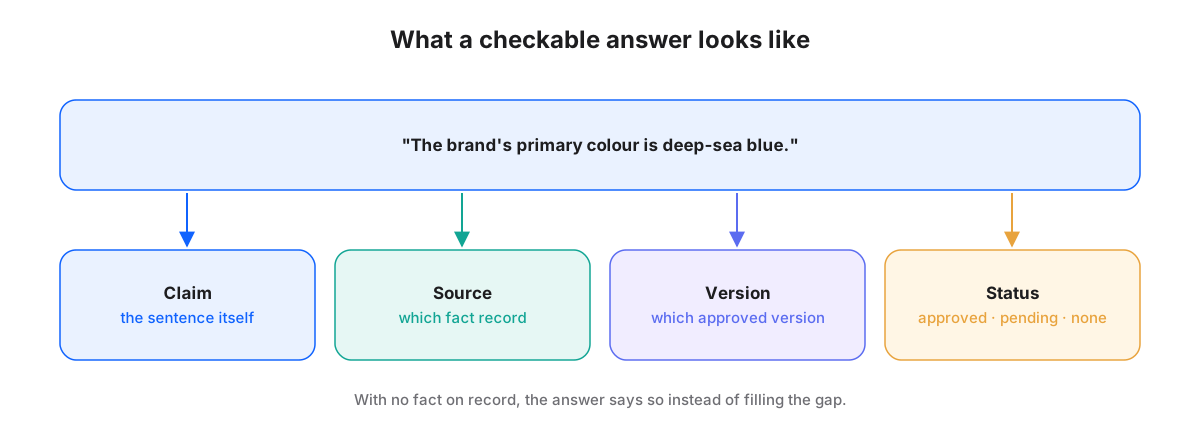
These four parts make checking cheap. A reviewer doesn't redo the research. They open the source and see whether the fact really says that and whether the version is current. If a fact changes later, you can also work backwards and find every place that cited the old version.
The crucial case is when nothing is found. An ordinary AI will naturally fill a gap with something plausible. We ask it to say "there's no approved information yet" and mark the gap as pending for a person to decide. On public pages, pending content carries a visible marker instead of being covered by a confident guess.
Better an honest gap than a well-written guess.
For the people using it, this changes how trust works. You don't have to believe an AI because it sounds sure, or recheck every sentence because it might invent things. You look at the status: approved can be used, pending waits, and no record goes to a person to fill. Trust moves from "feels reliable" to "can be verified".
Start small
Building a knowledge base like this doesn't mean organising every piece of brand knowledge at once. A more practical start is where questions are most frequent and mistakes most common: the correct spelling of brand names, agreed terminology, a few core claims, and the things you must never say.
Take those few dozen facts through the whole path: quarantine, checks, approval, query, citation. Once the flow works, widen the scope step by step. Every time an AI answers "no record", it's a reminder that a fact is worth adding. Over time the knowledge base grows along real needs, not along someone's imagined complete table of contents.
In short
- Brand facts have one home. the fact store is versioned and traceable, other places reference rather than copy, and new claims must pass quarantine, checks and human approval.
- AI reads facts through a read-only query layer, and every result carries its source and version. AI can propose, but it can't approve or write directly.
- A checkable answer includes claim, source, version and status. When nothing is found, say so and mark it pending rather than filling the gap with a guess.