Goal chains: tracing every task back to strategy
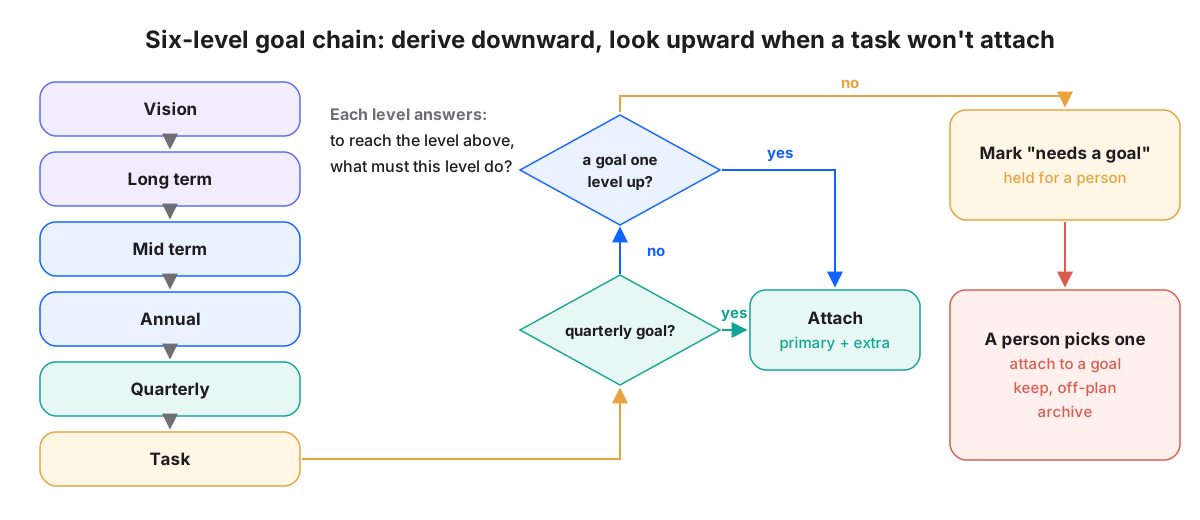
Company goals sit in six levels: vision, long term, mid term, annual, quarterly and individual tasks. Each level is derived from the one above it and can say what it must achieve to make that level possible.

Key points
- Company goals sit in six levels: vision, long term, mid term, annual, quarterly and individual tasks. Each level is derived from the one above it and can say what it must achieve to make that level possible.
- Every task attaches to one primary goal plus a few it also contributes to, and the link is checked automatically at four moments: opening, daily, when quarterly goals change, and closing.
- A task that won't attach is never dropped. The system looks one level up, and if nothing fits it marks the task as needing a goal, so a person can attach it, keep it off-plan, or archive it.
A busy team isn't necessarily a team moving the company forward. Everyone has several things on the go and someone is pushing each one. But ask "when this is done, which company goal gets closer?" and the answer is often unclear.
That isn't laziness. It's a missing line between the work and the goals. Without that line, no amount of effort can tell you whether something is finished or whether it was worth doing. As the number of projects grows, it gets harder to see which ones move the company and which ones just keep people busy.
This article explains how we tie every piece of work back to strategy: a six-level goal chain, plus a matching step that checks the links for you every day.
A six-level chain, derived from the top
The chain starts furthest out, with the vision: what the company ultimately wants to become, roughly ten years away. Below that come long term (three to five years), mid term (one to three years), annual, quarterly, and at the bottom, individual tasks.
Each step down answers the same question: "to reach the level above, what does this level need to achieve?" Say the annual goal is "launch three courses". The quarterly goal might be "run the first class in Q4". We call this deriving downward. Its benefit is that every level can explain its relationship to the one above, so no goal appears out of nowhere.
Where do goals come from? We split strategic input into four sources: core beliefs and values, the founder's thinking and everyday words, the outside environment, and market and customer needs. The first two are internal and change slowly; the last two are external and change quickly. Each has a fixed home, so whoever writes goals knows what to consult.
In practice you don't need all six levels on day one. Starting with annual and quarterly is enough, because that's where daily work connects most directly. The further-out levels can be filled in as strategy conversations mature.
How a task attaches to a goal
Every task has one primary goal and may list a few others it also contributes to. A brand course, for example, might have "run the first class this quarter" as its primary goal while also contributing to "raise brand awareness". The primary goal sets direction; the extra links make sure its full value is visible.
Matching isn't a one-time step at setup. The system checks at four moments: when the task is opened, every day, when quarterly goals change, and when the task closes. At opening, the preview card already suggests a primary goal and extra links for a person to confirm. When a quarter ends, its goals end too, and every task has to find a new parent.
That daily check is where the chain earns its keep. Each day the system rebuilds the company's status from the files and spots which tasks have no goal, which are falling behind on their indicators, and which are due with nobody moving them. Those findings go onto the day's list in three parts: waiting on a person, ready to push, and simple reminders. People start the day by reading only the first part.
There's a clear division of labour here. What the goals say is decided by people, through strategy conversations; the AI doesn't set the company's direction. How goals are stored, linked to tasks and checked each day is the platform's job. People own the content, the system owns the connections.
What if nothing fits? The matching step looks upward: no quarterly goal, so try annual; no annual goal either, so the task is filed under a strategy category and marked "needs a goal". That mark means "held here until someone looks". It always shows up on a person's decision list and never quietly disappears.
After looking, the person picks one of three: attach it to a goal, keep it as off-plan, or archive it. Off-plan isn't a failure. Some exploration shouldn't be tied to a goal at all. What matters is that a person made the call and it's on record.
Write goals the AI can actually work with
If a goal is vague, the AI can't check it daily. So every quarterly goal has the same six fields: a fixed identifier that's never reused, one sentence describing where things should be by quarter's end, key results that define success, the department responsible, the line of business it belongs to, and the annual goal it rolls up to.
Each goal should also answer five questions: why, what, how much, by when, and what gets delivered. And it needs at least one leading indicator and one lagging indicator. With lagging indicators alone, nothing is visible until results arrive, and the AI has nothing to push on day to day.
- Change or maintain: things you want to change use OKRs. The objective is a direction; key results can be numbers, milestones or qualitative criteria. Things you want to hold steady use KPIs, which are always numbers with a threshold. The two can be combined with weights, such as 70% OKR and 30% KPI.
- Three kinds of measure: a number must say where it's read from; a milestone must say what counts as reached; a qualitative criterion must say who judges it and on what basis.
- Three levels of clarity: clear goals go ahead as normal. Vague goals can still open, but stay in an incubating stage; after four weeks a person chooses to narrow the scope, switch to waiting on others, or archive. Goals waiting on others record what they're waiting for, from whom, and the latest date to check again.
Big goals made of smaller ones
Some goals are too big for one sentence and need to be split into sub-goals. Once split, the parent's progress is computed from its children, never typed in by hand. Hand-entered progress drifts easily; computed progress means every number has something underneath it.
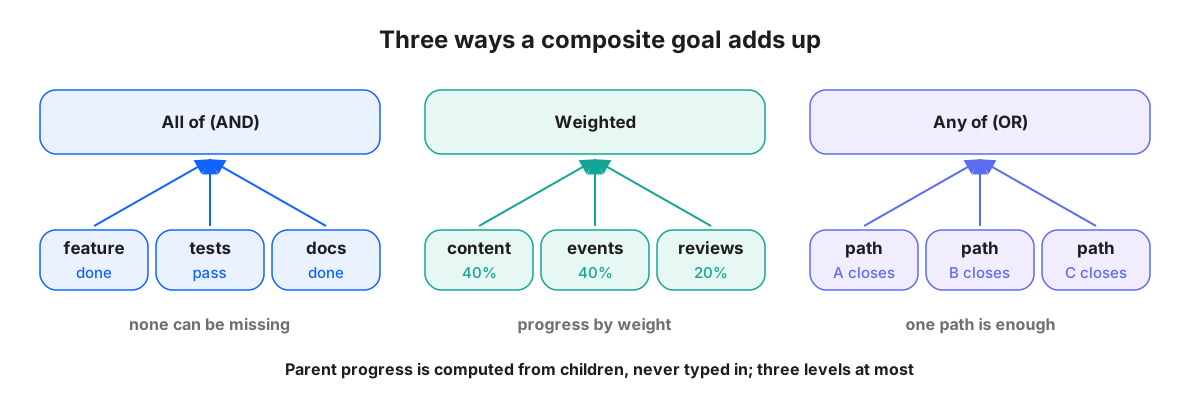
- All of: "launch" needs the feature done, tests passing and documentation finished. Nothing can be missing.
- Weighted: "brand awareness" is made of content, events and word of mouth, each with a weight, and progress is calculated by weight.
- Any of: "win the first customers" counts as soon as a course, a consulting engagement or a product closes a deal.
Sub-goals can live in the same task or span several tasks. But they go at most three levels deep. Anything deeper usually means it should become its own task, with its own goal and its own rhythm.
Work without a goal can't tell you whether it's done, however hard people push it.
In short
- Goals sit in six levels, derived downward from the vision, each able to explain its link to the level above. Start with annual and quarterly.
- Each task has one primary goal and a few it also contributes to, checked automatically at opening, daily, at quarter change and at closing.
- Tasks that won't attach look upward first, then get marked as needing a goal, and a person decides whether to attach, keep off-plan, or archive.
- Goals have six fields, answer five questions and include at least one leading and one lagging indicator. Composite progress is computed and goes three levels deep at most.